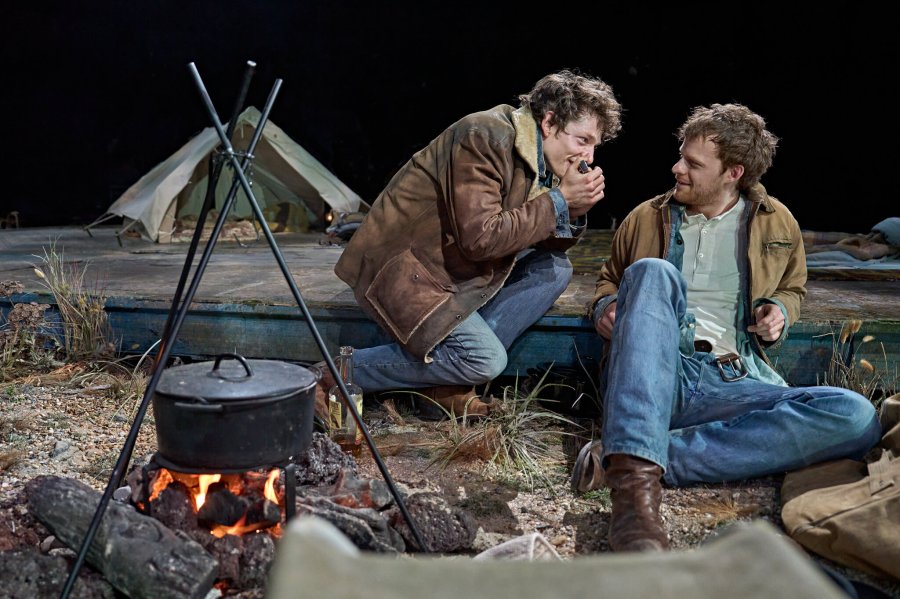
Though the West End’s Brokeback Mountain is billed as an adaptation of Annie Proulx’s original short story, most audiences will compare it to the movie.
Because the movie is more famous, because cinema and theater are more similar to each other than they are to literature, and because casting two up-and-coming movie stars — Lucas Hedges and Mike Faist — can’t help but draw parallels with Heath Ledger and Jake Gyllenhaal.
Regardless of the relative merits between the movie and the play, the conversation they enter into is worth a mull, particularly in regards to the acting.
Watching the production with the movie in mind provokes thoughts on the nature of screen-acting versus stage-acting, not only through juxtaposing the two pairs of thespians, but even by evaluating Hedges and Faist in relation to their own big-screen work. Given the intimacy of the brand-new Soho Place (I refuse to use the social-media whorish @ symbol), no audience member sits more than six rows away, a proximity that can make it feel like you’re on set with them, but without a screen between you.
And the concept of “location” seems central to the decision to move Brokeback Mountain to a live setting. In the movie, the screen operates as our window onto the actual mountain, albeit filtered through the unforgettable intermediary of the screen itself. In a theater, however, the stage can double as the mountain only through the art of suggestion, but what’s lost in verisimilitude is attempted to be gained through corporeal presence.
There’s no middleman between us and their romance; we hang with them on that mountain, existing side by side with their physical reality. How does this arrangement alter our relationship to the material?
Whether successful or not, this approach breeds fertile ground for comparative contemplation.
 Write All Nite