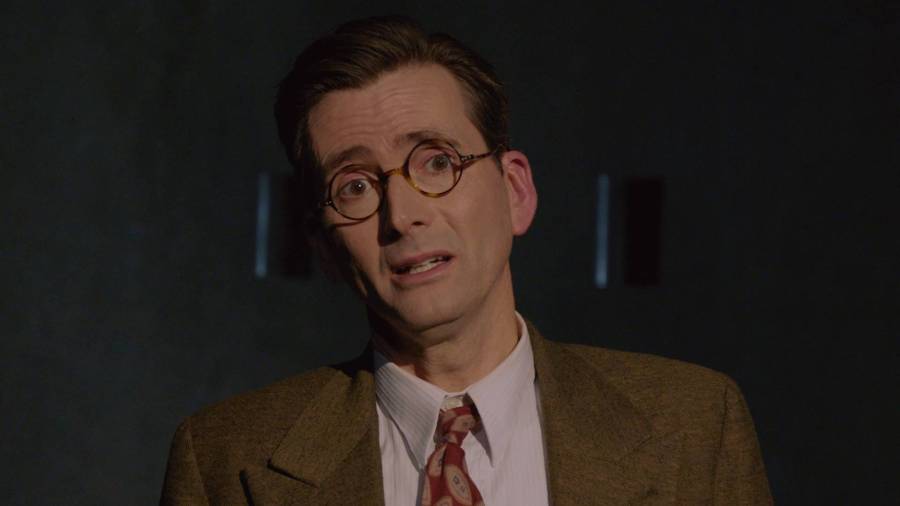
Prediction: theater historians will remember the 21st century for the mass dissemination of filmed productions.
As such, it would behoove the industry to contemplate how to effectively record a medium long-defined by in-person transience.
Towards this end, the National Theatre Live version of the David Tennant-starring GOOD raises a non-binary conundrum: should these broadcasts document for posterity a production exactly as performed on stage nightly — the 20th century’s archival approach — or should they utilize the power of the camera to adapt-cum-alter the show for screen audiences?
Direct address pervades C.P. Taylor’s play, and NT Live must’ve instructed the actors to deliver these monologues straight into the SOMETIMES-MOVING lens. I assume the cast normally focused these soliloquies towards the house . . . but short of confirming with an IRL attendee — trickier for future scholars — there’s no way to know for sure.
These close-ups increase immersion . . . at the expense of archival verisimilitude. Recordings can consider where on this spectrum to fall, on a case-by-case basis, situational to the dictates of the material.
 Write All Nite