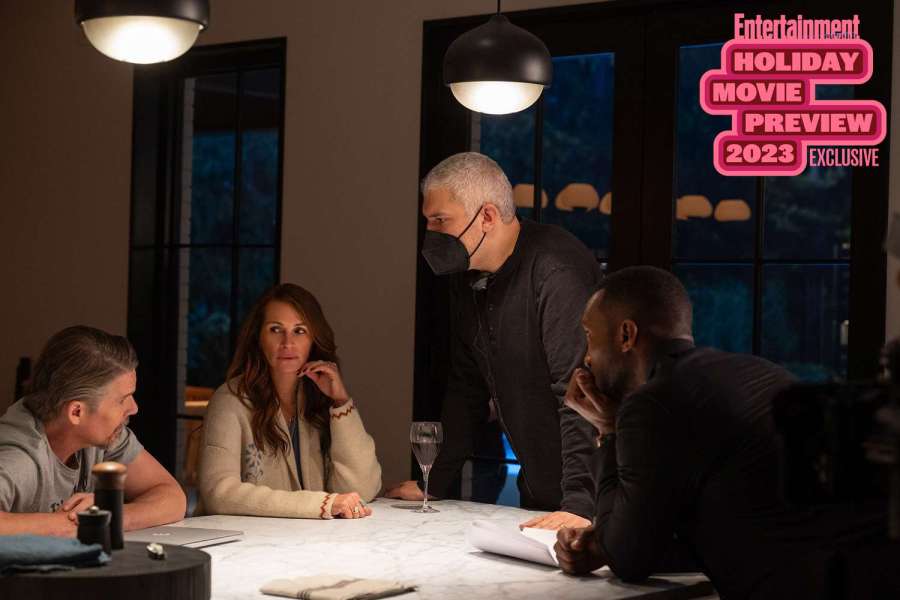
Leave the World Behind has been put through the Covid ringer, transforming it into an artifact of how the Covid Era shapes contemporaneous art.
The novel — about being quarantined at the end of the world; are you sensing the Covid parallels yet? — hit shelves in October 2020. Even if author Rumaan Alam started writing as soon as Covid infected the first victim, it’s highly unlikely that the book would be ready for publication less than one year later.
And yet, given the subject matter and the global environment the text was released into, the story felt like a response to Covid, read by those in a similar lockdown as the main characters.
And now, Netflix has turned it into a Covid Movie. I don’t mean that adapter Sam Esmail made it explicitly about Covid; rather, a “Covid Movie” has become a genre unto itself, and the screen version of Leave the World Behind bears its burgeoned hallmarks: a small cast isolated in a solitary location, usually a house, with abandoned surroundings as an added bonus to justify the Covid-friendly filming conditions.
And because Esmail had witnessed how people actually responded to the apparent end of the world in real life, he applied this empirical evidence to change the original ending.
The novel concludes with the youngest daughter pursuing survival, without spelling out what her survival life might look like. But Esmail had just seen what the younger generations seemed to value as Covid threatened to topple the globe. As such, the movie ends with the daughter finding an abandoned house full of what seems like a lifetime supply of resources.
Does she notify her family to share in the lifesaving bounty?
Nope.
Instead, she holes up in front of the mansion’s massive television to enjoy her happily-ever-after: finally being able to finish watching Friends, a binge previously cut-short by society’s full-systems collapse.
When Alam first put pen to paper, such a cynical resolution may have been too hard to believe. But after Covid, it rings surreally true.
And the fact that this new ending appears in a Netflix movie allows it to operate as a self-criticism of streaming. When she picks up the TV remote, there’s a close-up of her finger skipping over a big, blood-red Netflix button to instead press play on a DVD of Friends. Netflix loves to sell itself as a widely-accessible archive of art — and it was a godsend of convenience during lockdown — but have fun accessing that art without the Internet.
In this way, the movie’s ending echoes Guillermo del Toro’s (and Christopher Nolan’s) ethical positioning of physical media:
And much like Esmail, GDT is also in business with Netflix; it’s almost like they’re taking Netflix’s money and using the platform to broadcast their fears over how Netflix could leave the world behind a worse place.
If the Internet falls, we’re left with physical media. And if all technology falls, then we’re left with what’s depicted in Anne Washburn’s play Mr. Burns — and in Ray Bradbury’s book Fahrenheit 451 — where once-recorded art only survives through relayed memory.
 Write All Nite