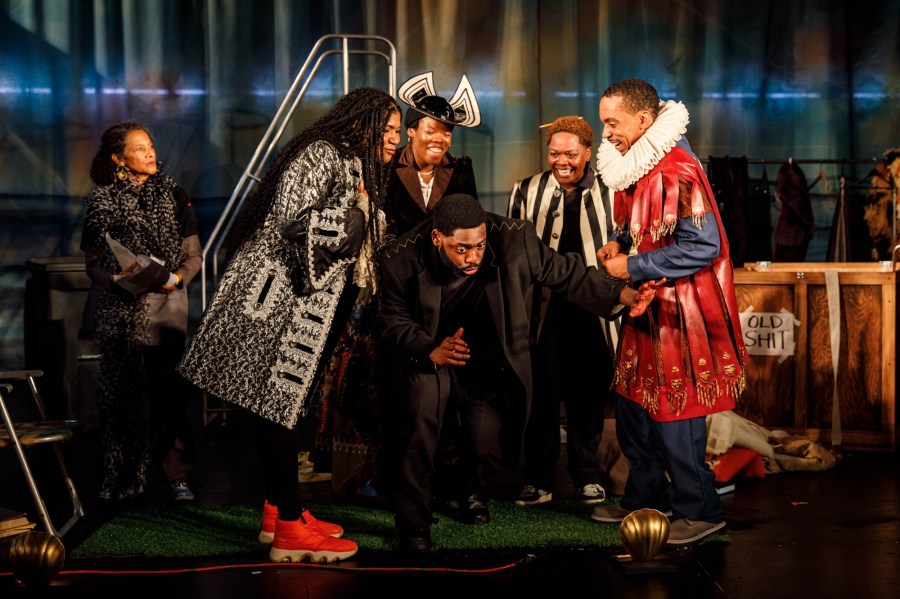
When you walk into Lincoln Center’s Claire Towe Theater for Phillip Howze’s world premiere play Six Characters, an usher will ask whether or not you want to sign up for audience participation.
If you say yes, they’ll hand over a wristband, but don’t hold your breath waiting for a cue; besides playing a role in an early joke involving a fourth-wall breakage, neither the wristbands nor their promised participation are mentioned again.
Which begs the question: why offer the wristbands at all, especially as the audience’s presumably-important first impression of the play?
What’s the significance of letting us believe we can decide to participate, yet never actually giving us an explicit opportunity to do so? How does this “false” expectation relate to the rest of Six Characters?
As a surveyor of unconventional curtain calls — the start and end of a production bear obvious import — I was struck by how Six Characters‘ cast don new costumes for their bows, made to look like the real outfits they could’ve conceivably worn to the theater.
Yet another instance of the production bleeding the barriers between performance and “truth.”
Meta-plays like Six Characters benefit from demonstrating an understanding of their own meta elements…which is why it’s so fitting that one scene takes place around the ultimate representation of the Claire Towe:
Those infernal elevators.
 Write All Nite