The relationship between the personal and the political is an evergreen framework.
Related to this framework, 1536 suggests that how political leaders behave in their personal lives affects how the populace behave in their personal lives. The personal life of a public figure cannot be considered “private” when they’re a ruler who uses the mechanizations of government to wield power over their interpersonal affairs.
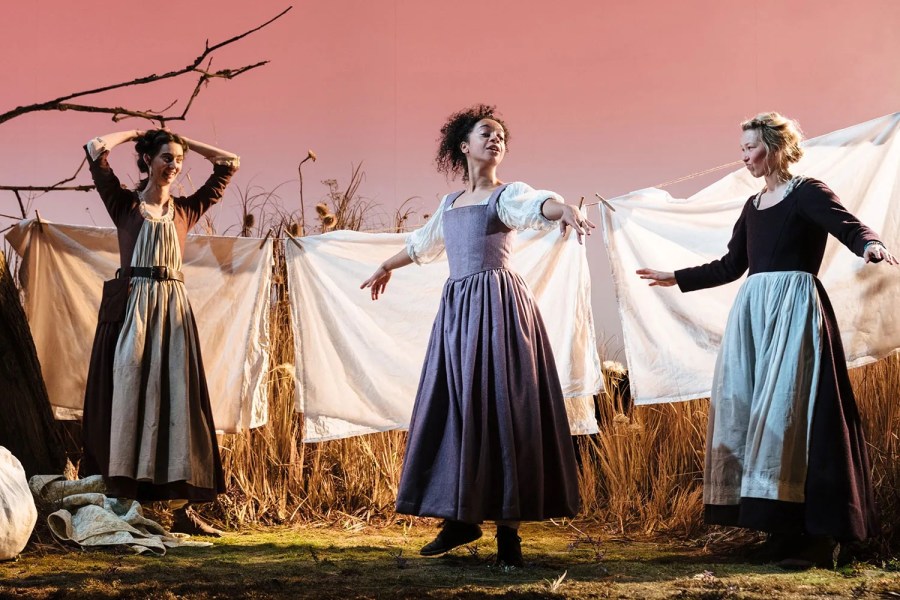
In Ava Pickett’s debut play, what starts as idle gossip about Henry VIII’s treatment of his wives among villagers in a rural field in England…spawns copycat responses throughout the nation. Henry’s actions enflame his society’s existing misogyny, emboldening the citizenry to mimic his sexism against “their” women.
1536 conveys Henry’s disruption of the established order by disrupting the established order of its dramatic structure. The play begins with a couple having sex, and their ensuing pillowfield talk. The next scene involves the gal chatting up her two female friends. The following scene returns to the couple for more boom-boom and chitchat…which is followed by another scene in which the ladies discourse. And then, back to the couple for more shtooping and discussing. And then, back to the estrogen for another conversational powwow.
This patterned structure is disrupted at the exact point in the story that Henry’s escapades start to disrupt the previous order of the village. Instead of another sex scene, a new character is introduced. This break in the dramatic pattern draws our attention to this belatedly-added, seemingly-secondary man, foreshadowing his ultimate importance to the story. Why the delayed entrance? Why set him up as separate?
If this scene conformed to the play’s initial oscillating, the lights would come up on sex. Instead, we’re greeted to the former fucker whacking a stick against a bush; can you say innuendo?
AND, can you say: connecting sex and violence?
Skipping to the ending, 1536’s final moment is staged so that the protagonist tries to flee her fate…by running towards the audience. But would our modern world even offer an escape from her problems? Or would she face different versions of similar issues?
 Write All Nite