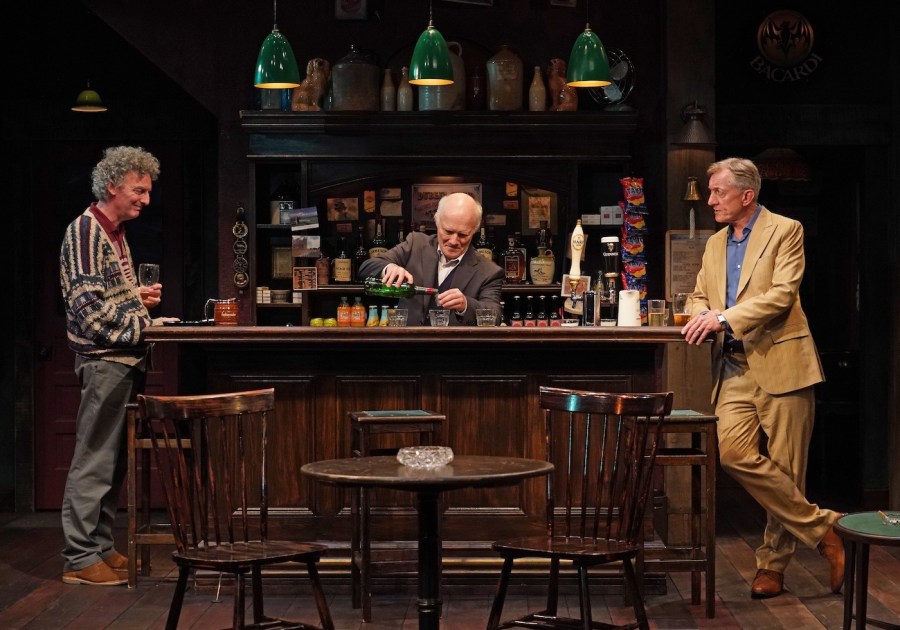
Why is the barkeep the sole character not to tell a ghost story in The Weir?
This query comes courtesy of how Conor McPherson’s play establishes a clear order to its dramatic structure…and then deviates.
The other four characters’ loooong, ghostly monologues bind together the text, comprising its dramaturgical spine; the current/forever Irish Rep revival emphasizes the centrality of these sequences by gradually dimming the lights and ramping up the volume of the background wind over the course of their periodic, episodic speeches.
But The Weir ends before the barman gets his chance to wax horrific…all while the buzziest barfly in the bunch is granted two soliloquies.
Is his second supposed to be a stand-in for what might become the barkeep’s spooky spiel later in his parallel life? The barfly is still haunted by the ghost of lost companionship, prompting his urging of the barkeep to find someone before he becomes him.
Might the gal be that someone? Yet her ghost story is a product of companionship, and she’s looking to be haunted by another form of companionship, through corporeal isolation from living humans.
Meanwhile, the other two chaps still have families, whose noted imperfections are still preferable to the fly’s loneliness. If the keep doesn’t settle down, his ghost story will echo the fly’s quietly tortured existence, for whom the camaraderie of the bar is insufficient comfort.
As he summarizes near The Weir’s conclusion, in both a blessing and an eerie warning:
“You should stay with the company and the bright lights.”
 Write All Nite