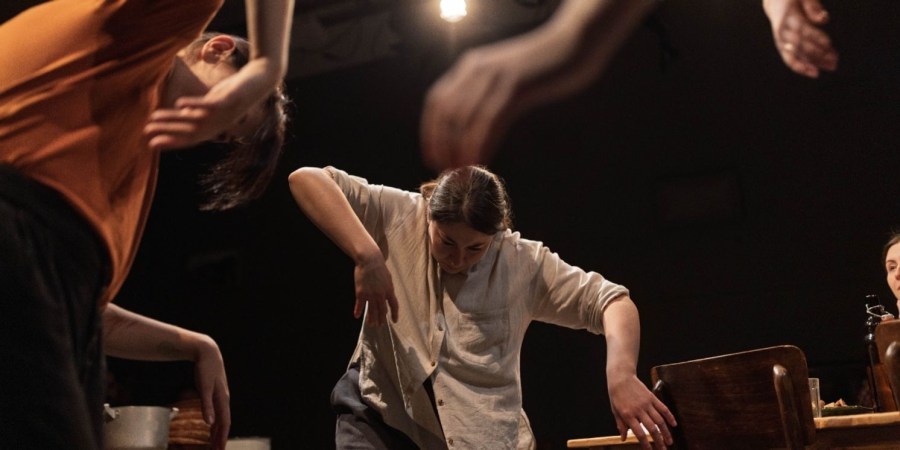
The ending of Richard Nelson’s When the Hurlyburly’s Done is proof positive of how applying auteur theory can alter analysis of the auteur’s individual works.
One of the defining traits of Nelson’s latter-day aesthetic is that his productions start with the cast setting up the scenery, and finish with them striking the set.
His new play When the Hurlyburly’s Done begins accordingly…but concludes sans an ensemble strike.
What gives?
Which is a question more likely to occur to audiences accustomed to Nelson’s traditional bookends.
Does this staging choice convey a lack of closure? Because the hurlyburly between Russia and Ukraine is self-evidently never done?
And, if the initial scenery set-up transitions us into the play’s based-on-a-true-story fiction, it seems meaningful that our transition out is replaced by an artifice-breaking time-jump that reveals the IRL fate of the factual characters.
Nelson n00bs would have to remember the opening moments to consider the why behind these decisions…whereas they stick out like a sore thumb for my fellow Nelson acolytes.
 Write All Nite