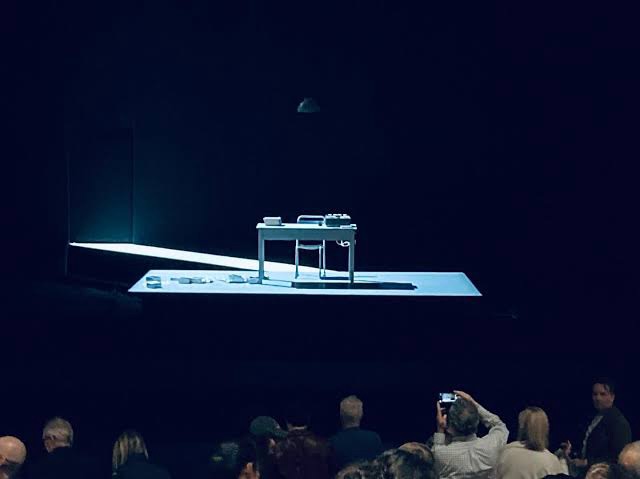
The NYU Skirball Center seems like an unlikely venue for Samuel Beckett’s Krapp’s Last Tape.
A play that primarily involves a lone man sitting at a desk wordlessly responding to past recordings of his own voice…produced in the cavernous confines of Skirball?!
Yet Vicky Featherstone’s production doubles down on this juxtaposition by recessing the desk even further away from the audience than the space requires. A conventional design would’ve planted that desk as close to the lip of the stage as possible, to minimize Skirball’s size. Instead, the desk is nearer to the back wall than our eyeballs, to such a degree that anyone who sat in the last row at Irish Rep for Krapp’s prior visit to New York (F. Murray Abraham!) would’ve felt more intimately proximal than the first row at Skirball.
This change alters the play’s usual means of expression.
First, Stephen Rea needs to outsize his facial expressions in order to be seen, a reminder of how the play shares a lineage with the performative likes of farce. Yet he still restrains himself, forcing us to really lean in to connect with the action (can you say thematic?).
Speaking of thematic: no matter the volume of his corporeal expressivity, the staging maintains a distance between our irises and his visage, redirecting our attention at not only his voice, but also his body’s both literal and figurative relationship to being within AAAAALLLL of that vaguely-defined, constantly-imposing darkness.
To quote my favorite line from Beckett’s Waiting for Godot:
“There’s no lack of void.”
The revival’s decision to leave the set illuminated after the curtain call doubles as a service to (certain) audience members. When exiting, you can turn around to clock how the set looks from different vantage points, specifically how the platform appears to be floating in space.
Potentially thematic question: why not keep the walkway visible, too??
Thematic interpretation of the lingering lighting: Krapp’s body might be gone, but the world persists, a static permanence in conversation with the play’s war between fleeting life and forever records.
A play about someone whose existence is defined by constantly recording himself, and then scrolling through old recordings instead of living…
#HitsDifferent in the social media era..
 Write All Nite