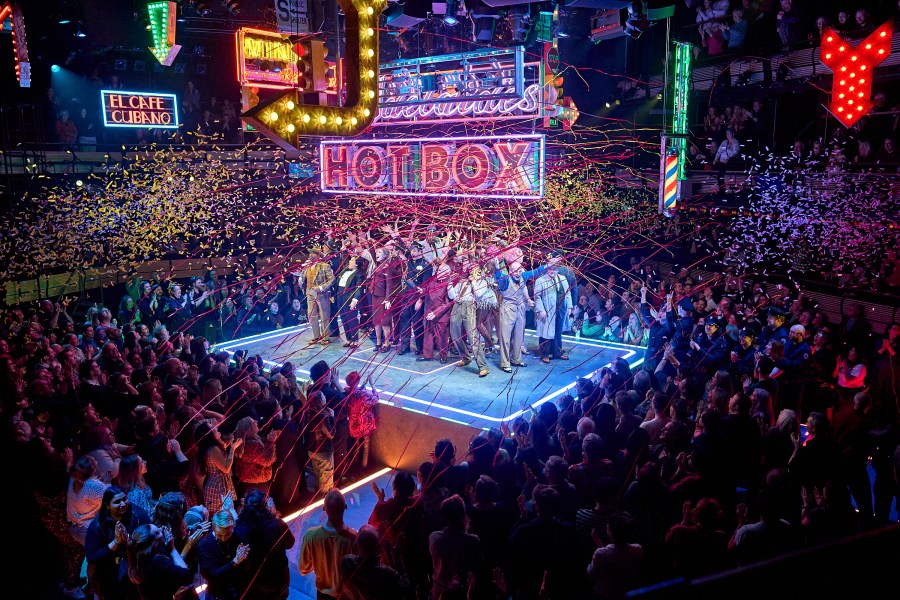
Ambulatory stagings like Guys & Dolls at London’s Bridge Theatre reposition the customary relationship between audience and art.
And, at least for the ambulating patrons, this repositioning never has to end, because we’re in control.
Usually, in a literal sense, your seat is your sole vantage point on a performance. The production elements might rotate or revolve, or your seat might even move (Hello, Broadway’s Rocky! Hello, Andrew Lloyd Webber’s original Cinderella!), but for the most part, your seat location dictates your perspective on the show, both literally and figuratively.
But The Bridge’s Guys & Dolls allows its standing audience members inside the playing space to ambulate around the action with unencumbered mobility. Don’t like your view of a particular sequence? Well, walk somewhere else, even in the middle of a scene (discreetly, behind the bulk of the crowd, without blocking anyone). Think of it like your own personal NTLive recording, except you’re the cinematographer and editor.
And because we’re accustomed to watching Guys & Dolls unfold within a proscenium — where the contours of the stage act as a static frame full of mutating tableaus that, taken together, tell the story — untethering the audience from this standard arrangement through corporeal-sightline liberation can’t help but change — or, shall we say, reorient — how we engage with this seminal text of theater history, from moment to moment, song to song.
This same calculus defines the production’s relationship between director Nicholas Hytner’s concept and Guys & Dolls. Why choose such an unconventional staging method specifically for Guys & Dolls, a musical that helped ferment musical conventions? This multi-pronged question creates a running commentary between the revival and the material, open to a legion of interpretations, both micro and macro, as to how the differences between the nature of a “normal” staging and the nature of an ambulatory staging — some inherent, some the result of artistic decisions — interacts with, and thus alters our conception of Guys & Dolls.
And even stationary audiences aren’t spared from this reconfiguring; as opposed to staring at a rigid playing space — the bounds of which are usually outlined by the solid structure of the stage itself — Guys & Dolls’ stage is comprised of platforms that rise and fall throughout, a spectacle of visual shapeshifting.
Curtain-call concerts? Old hat.
Guys & Dolls’ post-curtain dance party? Novel.
 Write All Nite