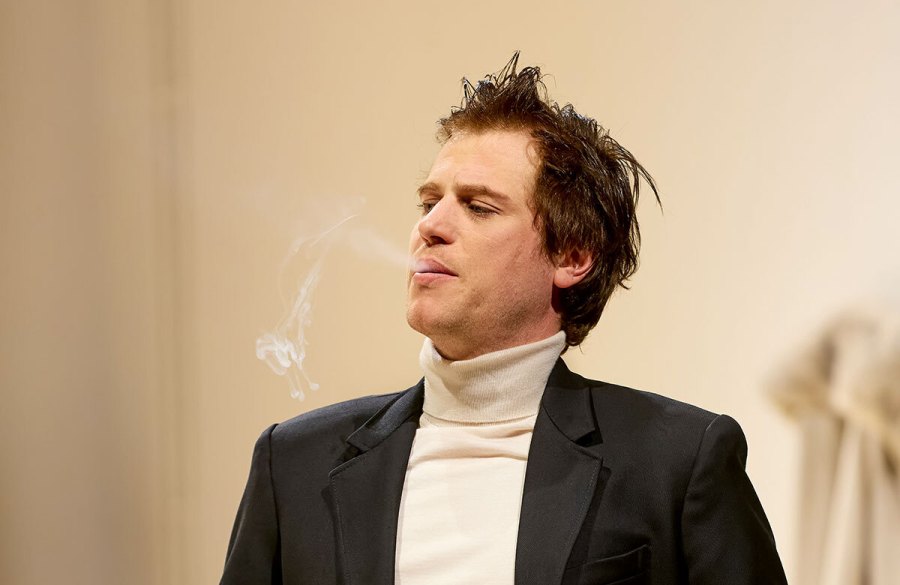
Johnny Flynn is the caliber of British thespian all but expected to eventually unleash his Hamlet on the world (or, at least, on London).
The Motive and the Cue, now at the National Theatre, offers glimpses of what his Hamlet might look like, albeit refracted through performance stipulations outside of Shakespeare’s original text.
Though Flynn delivers a few of the famed soliloquies, he’s not strictly playing them as Hamlet. Rather, he’s playing Richard Burton playing Hamlet. Or, more specifically, Flynn is playing Burton as Burton is trying — and flailing — to find his version of the character during the rehearsal process, circa 1960 (and all the conditions weighing on Burton during this time — personal, professional, celebratorial).
Oh, and Burton’s production was intended to feel like a rehearsal run-through — he wrestles with WTF “a rehearsal run-through” even means — all while contending with acting under the directorial shadow of Shakespearean-titan John Gielgud, and his hallowed history with the material.
So The Motive and the Cue somewhat allows Johnny Flynn to join the hallowed history of British greats tackling Hamlet, but in a more tangential relationship to this lineage, predominantly informed by these Burtonian contextual parameters.
And in a nice bit of meta-layering, The Motive and the Cue‘s story is explicitly about how the power and mystique of Hamlet‘s legacy influenced this Burton-Gielgud revival; navigating the conflicts that arise from trying to find your way within this legacy is a driving force of the play’s drama. This same legacy also hovers over The Motive and the Cue, all while the play actively explores its nature.
And the brief moments we get to see of Johnny Flynn’s Hamlet can’t help but enter into a relationship with this legacy.
 Write All Nite