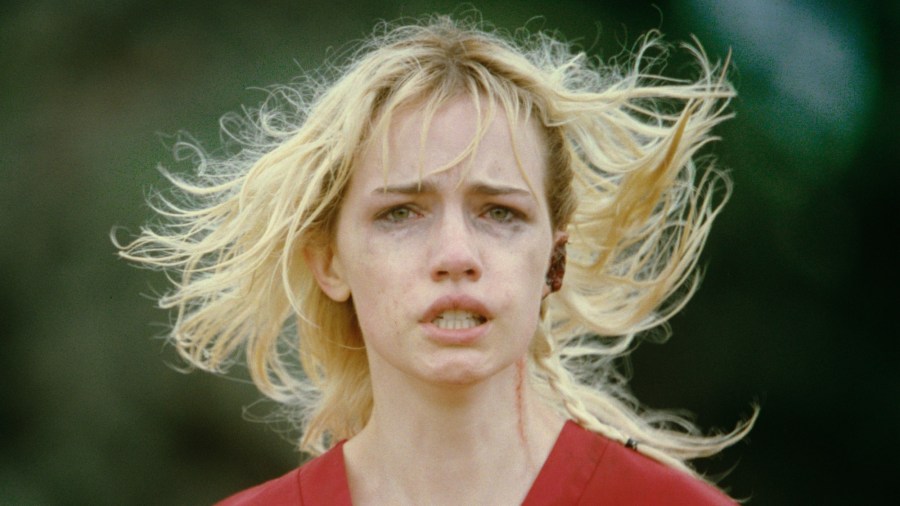
When a horror movie starts with an armed aggro chasing a bloody blonde, conditioned audiences will expect her to be his victim.
To wit, Strange Darling’s opening credits labels them as “The Lady” and “The Demon.”
But these labels prove to more accurately describe our conditioned expectations, not who the characters turn out to be. It’s this exact conditioning-by-stereotype that allows Strange Darling’s depicted atrocities to occur, the most extreme example being a late-movie warning about the possible perils of always #BelievingAllWomen.
Not all narratives show us the world as it usually is. Some can be about exceptions to the rule, including exceptions that cause harm by understanding how to hide behind widespread notions of the rule.
There’s a reason the title describes the barbarous broad as being a “Strange” Darling; the dictionary definition of strange: “unusual or surprising in a way that is unsettling.” Expecting all individual examples to conform to generalized patterns can allow for the devilishly strange to thrive right under our erroneously self-assured noses.
 Write All Nite