Differentiation is a form of highlighting.
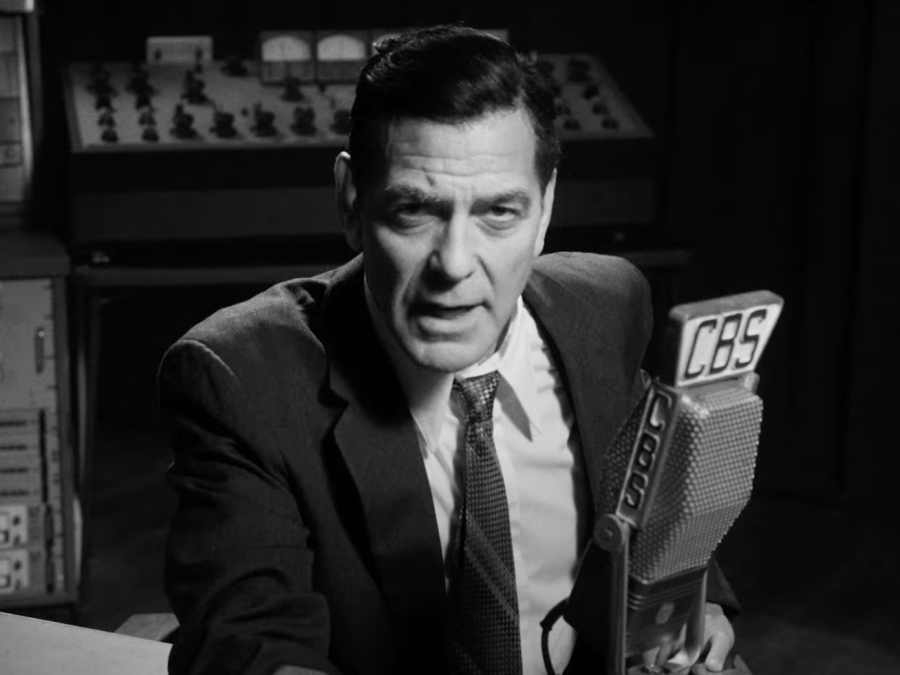
Case in point: George Clooney dropping his Edward Murrow accent to accentuate the importance of one specific line in his monologue that ends Good Night, and Good Luck.
Until this point, his performance mimics the serious-newsman sound of Edward Murrow’s voice. But during his final speech, when he repeats the beginning of, “The fault, dear Brutus…” from earlier in the play, he ditches the Murrow accent for those four words, and instead speaks like…well…like George Clooney, before finishing the rest sounding like Murrow again.
This sudden intrusion of reality that disrupts the production’s constructed artifice draws attention to the quote, signposting its significance to what this iteration of Good Night, and Good Luck seems to want the audience to take away.
Given his IRL antics — and given Broadway’s sociopolitical reputation — George Clooney’s presence in a story about politics and journalism could lead us to expect a TDS echo chamber that contorts the history of Murrow and Joseph McCarthy into a Trump-bashing parable.
While that’s definitely an ingredient in its stew, Good Night, and Good Luck appears to suggest that the lessons to learn from Murrow and McCarthy apply to all sides of the political aisles, as evidenced by the inclusion of a clip during Clooney’s concluding broadcast of CNN claiming Biden had a photographic memory.
As his accent-switch emphasizes, the finger of blame when it comes to diagnosing the faults in the relationship between media and politics can be pointed at Republicans and Democrats, liberals and conservatives, and segments of other stripes and affiliations. If the fault is not solely in any of them, then it’s in all of us.
AKA: the fault is in ourselves.
 Write All Nite