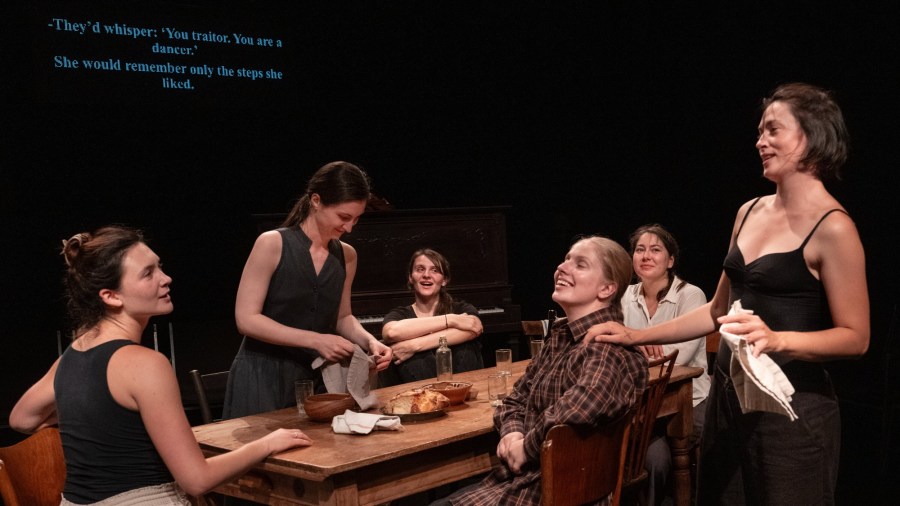
The vast majority of subtitled productions project the translated text line by line onto screens around the stage/house.
Basically, the screens will show only one line of dialogue at a time, simultaneous with the actor speaking that specific line (albeit in a different language…obviously).
This arrangement forces the audience to dart our eyes back and forth between screens and stage, which can be exhausting.
But Richard Nelson’s When the Hurlyburly’s Done opts to include multiple lines of dialogue on screen, which replaces the eye-darting with mismatching the speed of our reading against the cast’s line deliveries. If you finish reading before they’re done talking, it becomes harder to figure out exactly what they’re saying at that precise juncture.
Which is a practical decision that doubles as a dramaturgical decision, because the choice fundamentally alters how the audience engages with the production, on a second-by-second basis.
And when a shorter line is granted spotlighted pride-of-place on an individual slide, this underscoring prompts consideriton of why these moments are separated as important.
 Write All Nite