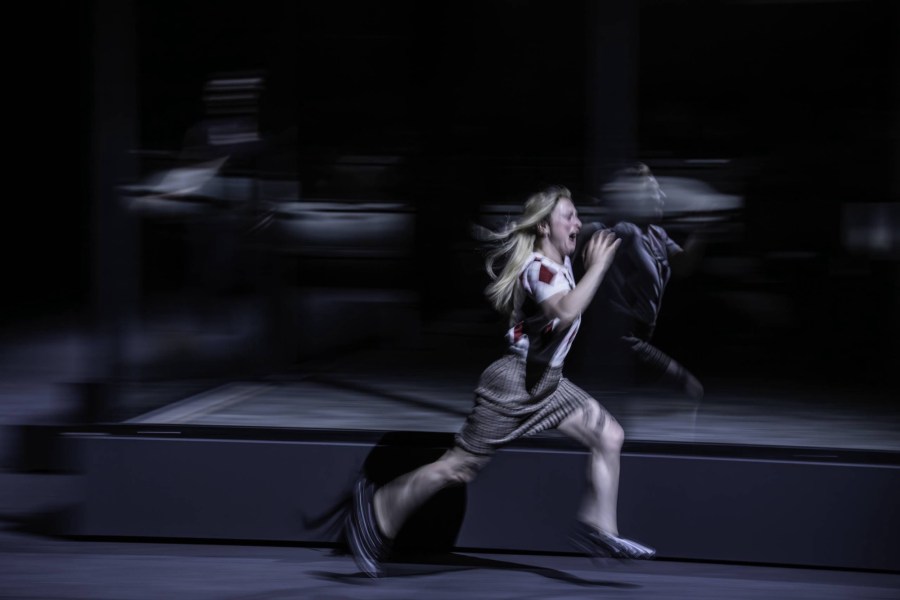
Unlike his The Cherry Orchard at the Park Avenue Armory, if you renamed Simon Stone’s The Oresteia, some audiences may not even realize the text is a riff on Aeschylus.
The shared title creates a gap between the Greek trilogy and Stone’s three-act play for us to fill in with our interpretations of their connections, especially with respect to the story’s foundational and enduring role throughout the history of western theater.
Our analysis can also reckon with the stylistic slipperiness of its seemingly incongruous tonal mishmash, which careens from horror — both psychological and slasher (the spinning glass house is perfect for the genre on stage)— to film noir, melodrama, farce, and absurdity.
This inconsistency (not a criticism) also pervades the behavior of the characters; why do they keep acting in ways that read as unrealistic, and even not believable? And, speaking of acting, why does the cast play scenes in an unexpected, and borderline unconvincing manner?
Welcome to the Simon Stone(r) stew.

