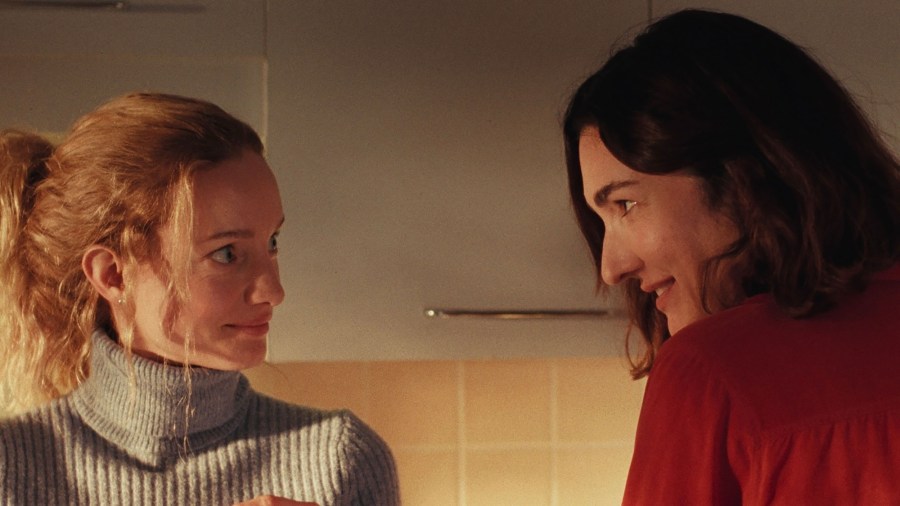
Two Women utilizes differential nudity for storytelling and character-building purposes.
Is there a difference between the two?
Even if the discrepancy is due to the varying consent of the actors, Two Women turns this practical choice into an opportunity to shade their arcs, in the sense that nudity appears to signify how much of themselves they’re truly putting into the depicted sexual interactions.
Even though the title is Two Women, three end up in situations that may or may not call for skin.
First up is Juliette Gariépy’s younger paramour, right after we first see her making the crowing noise, basically this new movie’s narrative engine. Her hair remains dangled in front of her nipples, a fragmentary reveal of her body. She’s enjoying herself, but the rest of the movie clarifies that she’s not TOTALLY committed to him; she can share only fragments of herself with him, literally and figuratively.
Meanwhile, Karine Gonthier-Hyndman’s full-frontal flaunter is TOTALLY committed to the carnality of her post-meds liberation. This lifestyle has become her preferred truth, and her complete trow-dropping reflects her shedding of her former conservative trappings, leading to her ultimate decision to leave her marriage.
And then there’s Laurence Leboeuf in between. When she’s sowing her wild oats, she keeps on her bra. But when she sleeps with her husband again, she’s top off, but below the waist remains covered. She stays with him for their developed intimacy, superior to what she’s found so far playing the field…yet she may just be making the same cyclical mistake as her parents.
He’s an imperfect fit for her, a doubt she’s conscious of. She knows he doesn’t see all of her. And thus, nor do we.
Why is the title Two Women even though it’s ostensibly about three? Probably because the titular two are at a seminal crossroads, whereas the more-youthful third is merely beginning to plow her path.

