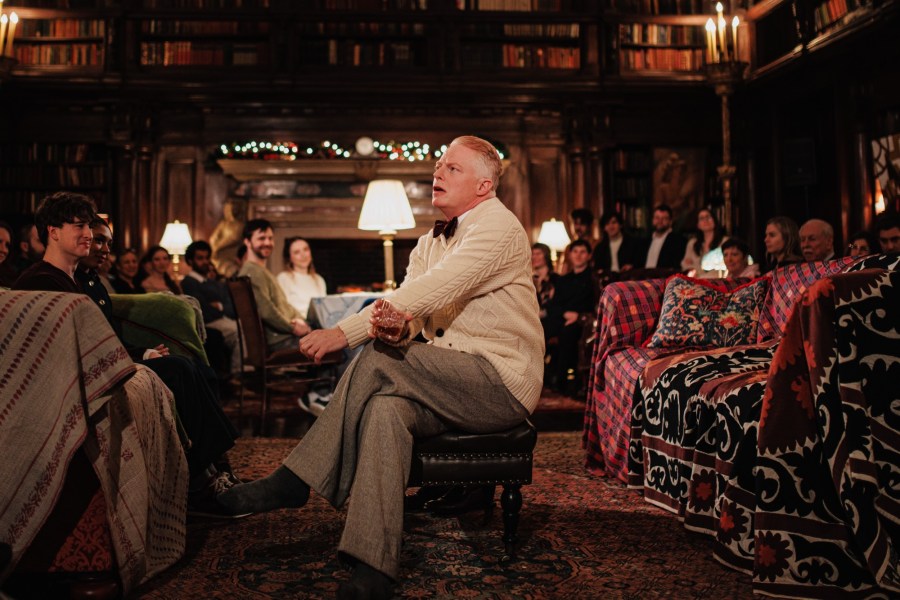
The most site-specific “theaters” in New York are House of the Redeemer and East Village Basement.
Scare quotes, because neither were built to be arts venues. House of the Redeemer is a once-private library within an Upper East Side mansion, and East Village Basement is a subterranean studio apartment in [take one guess].
Their recent tenants showcase how the specifics of these sites can be utilized by the produced material.
House of the Redeemer is the exact sort of locale — in the exact neighborhood — where Tru’s Truman Capote would’ve spent his New York days inhabiting. In fact, the Gilded Age palace was built by a Vanderbilt, and Jay Presson Allen’s play chronicles the fallout after Manhattan socialites like the Vanderbilts ostracized Capote — and (and because of) his fat mouth, moved here by Jesse Tyler Ferguson — for publicly airing their salacious laundry.
Capote’s portly gob — and oh what a gob it will always be — is Tru’s primary motor, and the backdrop of House of the Redeemer adds verisimilitude around his ceaseless gabbing. Back in the play’s 1975, Capote would’ve found himself in a drawing room much like House of the Redeemer, alternating between loneliness-coping gossip with the few friends still willing to accept his phone calls, and monologuing about himself to we-his-audience (AKA: the act of writing).
Decades after his death, he’s still populating similar brick and mortar, still mostly alone — except for the Charlotte-d’Amboise-embodied spirits of the women he wants back in his life (House of the Redeemer has haunted vibes, and wouldn’t Truman’s dames constitute fitting haunts?) — and still yearning for connection through his indefatigable words. Yes, he still attracts a crowd (it us) all these moons later, but forever fans are no replacement for mortal-coil companionship. As in David Cale’s The Unknown — one-person dramaturgy serves as an apt vehicle for depicting a scribe’s existence — his need for mass attention ultimately pushed away his IRL friends, but ensured his Tru-perpetuated immortality.
Given East Village Basement’s domestic digs, it’s the perfect setting for The Listening’s horror stories, a genre of haunted houses and home invasions. Its collection of spooky vignettes combine live audio and recorded audio designed to unsettlingly disorient, because the headphones obscure the ability to differentiate between the two. Are we hearing artificial sounds, or are the spooky noises actually coming from inside the dungeon claustrophobically surrounding us??

