What’s up with the mid-play shift in A Woman Among Women?
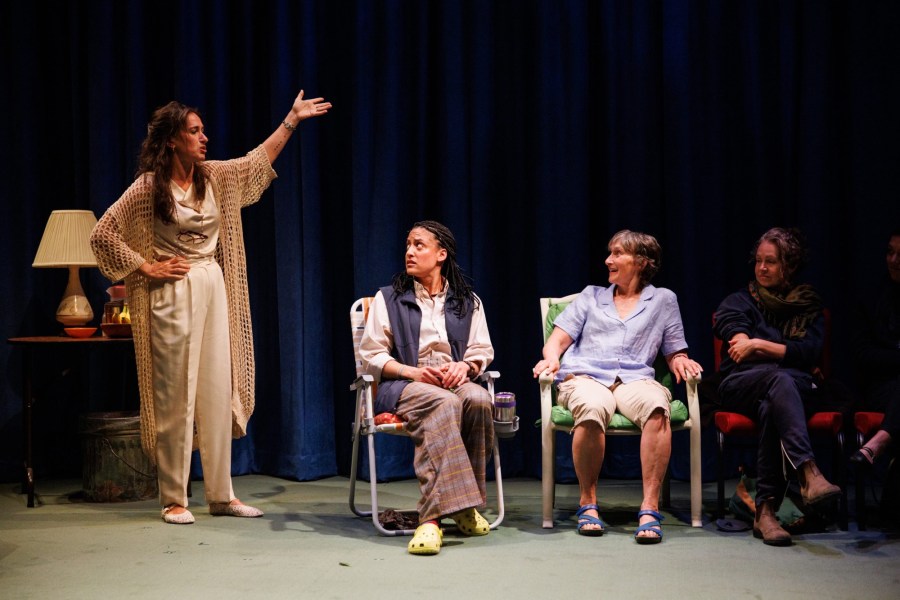
Initially, the decision by Sarah Cameron Hughes’ LCT production to seat parts of the audience among and around the action emphasizes the communal aspect of the Arthur Millerian yard-setting for Julia May Jonas’ All My Sons riff. Most revivals of his work silo the locale behind a proscenium, dividing the audience from the world of the production. But Miller’s oeuvre is steeped in the porous reality of local neighborhoods, shrinking the barrier between private life and public life, and A Woman Among Women’s seating arrangement literalizes this shrinking.
But then, about halfway through, the musician character explicitly references the presence of the audience, before leading us in a sort of singalong. While this happens, the onstage chairs are moved to the other sections, and a rear-wall curtain parts to reveal a typical Millerian porch…at the exact moment the story transitions from public knowledge to private knowledge.
The set becomes colored in with specificity at the precise juncture the text colors in specificity on the secrets that govern what we’ve already seen, repositioning our conception of the whole.
Speaking of the musician, the final dance feels like a callback to the line, “We’re dancing on the bones of the dead” (another way to describe a revival in this remix of a classic?).
A Woman Among Women counters by suggesting that history also dances on our living bodies; those old houses still stand, and All My Sons is still produced beyond Miller’s mortal coil.
 Write All Nite