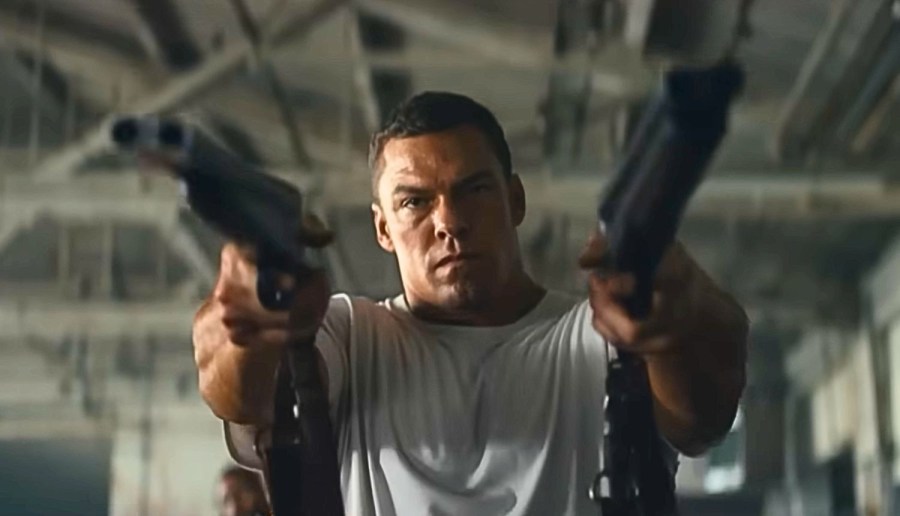
Motor City made me realize that the Sabanification of the action mainstream will result in my biggest bugaboo with the genre becoming even more difficult to overcome.
Sabanification refers to the penchant for Saban Films’ B-movies — [Max Bialystock voice] “Is there any other?”— to boast action premises…with scant few of those peskily-expensive action scenes.
Which means most of their runtimes will be devoted to non-action.
Which is my nightmare, because my aforementioned bugaboo is that the genre spends too much of their durations on non-action. Do the best action movies find ways to be entertaining between the battles? Of course. And do these elements ultimately elevate the actual bloodshed? Duh.
But for the most part, such dramatic hallmarks as character development and exposition feel like treading water.
Motor City energizes these portions through the age-old theory that self-imposed restrictions are a breeding ground for creativity. With almost no words spoken throughout, the fun of the non-action becomes rooted in how the movie keeps justifying the silence.
Motor City’s concept almost proves the point of my bugaboo: action movies rely on nothing more verbally specific than can be conveyed purely through visuals (AKA my dream version of A Quiet Place). We remain locked-in during this build-up because of the action promised by the first scene, and it’s true to the genre to start with a blip from the violent climax, a taste of what’s to come to get us through my bugaboo.
Speaking of genre tropes in Motor City, an action hero shaving their head for the finale serves multiple purposes:
First off, badass war-mode.
Second, the character becomes incognito to the big baddies on their prowl.
And, after the opening’s tease, flashing back to their hair era is an easy temporal marker.
Speaking — or, in Motor City’s case, not speaking? — of being true to genre, dialogue-light scripts tend to harken back to silent movies…but not Motor City.
It’s more of a 1970s throwback — especially the premise, production design, costumes, haircuts, soundtrack, and my guy Pablo Schreiber transforming from his tall-and-lanky stage days into…somewhere between New-Hollywood Al Pacino and Jon Bernthal?!
(Less so for the cinematography, editing, storytelling, acting, and score).
A certain brand of retro movies love to slap the trademark line onto their title cards.
The danger: when the name of the listed LLC is cooler than the chosen title.
Dish Served Cold??
Speaking of revenge, Motor City gestures at refraining from allowing Alan Ritchson’s protagonist to fully serve his dish; after the concluding set piece, a sequel set-up is suggested when the music swells on a zoom-out that would usually trigger the closing credits, after big-bad Ben Foster escapes alive…
But then, Motor City grants us our satisfaction after another (except this one is unexpected) time jump, all while leaving open the possibility of a future installment that connects the dots between these narrative points.

