Chronovisor isn’t the sole movie in theaters now to turn down the dialogue in the sound mix.
When you think of Virginia Woolf, her association with WORDS WORDS WORDS probably springs to mind. And yet, the new adaptation of her Night and Day lowers the volume on the spoken word, even though characters chatter as often as in a conventional script.
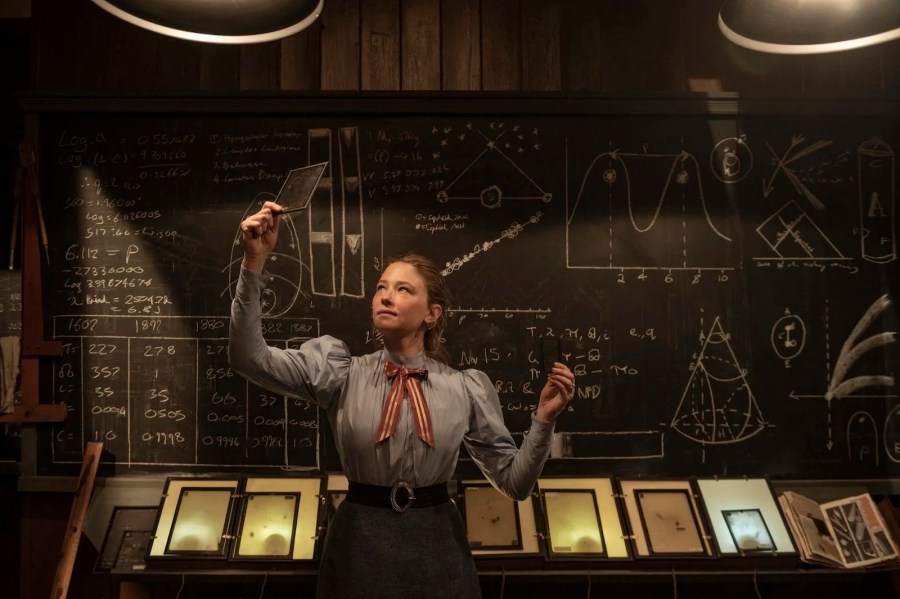
In literature, words are the primary means of artistic expression…but the homies know that speech is but one means of expression in cinema. Woolf put words to the relationship between exteriors and interiors that required language to understand and convey, but for Haley Bennett’s protagonist in Virginia Woolf’s Night & Day, the verbal is not of primary interest. Instead, she’s a gal of numbers and space and time. In fact, words are a source of limitation, a means of her gender oppression; her sights are set beyond the scope of the words reducing and inhibiting her freedom.
As such, they’re lower in the mix of the movie’s subjective perspective, replaced in prominence by thumping music and in-their-faces imagery. Virginia Woolf used words to alter our perception, while Virginia Woolf’s Night & Day uses nonverbal cinema to reorient our relationship to Woolf’s literary world — the modern score, the handheld cinematography (instead of her milieu’s typically-lush shots). The coarse close-ups cut portions of the characters’ heads outside of the frame, an insufficient encapsulation of their wholes.
As words were for the ladies.
Lily Allen’s bad singing jests around with my theory that, if you cast an actor who can hold a tune, find an excuse to let them belt.

